Why Procurement Is No Longer Just About Price & How It Impacts Bankability
July 7, 2026
Project development procurement used to be about finding the right equipment at the right price. Today, it’s more like solving a Rubik’s Cube. Every move affects financing, project viability, tariff costs, domestic content compliance, project schedules, and long-term risk. To be successful, it now requires deep experience, foresight, and a clear understanding of how all the pieces fit together.
Foreign entity of concern (FEOC) requirements, tariffs, and domestic content incentives have dramatically reshaped clean energy procurement over the last 12 to 18 months. TruGrid’s procurement team takes a proactive, strategic approach to sourcing, helping customers navigate evolving regulations while balancing:
- Equipment availability and lead times
- Tariff exposure and cost impacts
- FEOC and country-of-origin requirements
- Domestic content objectives
- Financing and bankability considerations
The challenge is that, much like a Rubik’s Cube, decisions in one area often affect every other area.
When Equipment Availability Becomes the Schedule
Lead times have always mattered, but today’s market conditions have made them far more consequential. For example, during the development of a recent project, our team at TruGrid procured quotes for a 100 MW / 200 MWh battery energy storage system (BESS) project. Domestic equipment options carried lead times of about 64 weeks, but comparable solutions sourced from China were available in roughly 32 weeks.
Some of the greatest schedule risks stem from equipment that rarely gets attention during early project planning. Transformers, high-voltage switchgear, and breakers that once carried lead times of around 46 to 52 weeks can now stretch to 120 to 135 weeks.
The result is that procurement decisions are increasingly becoming scheduling decisions. That’s why we work with customers early in project development, providing visibility into market conditions, supplier availability, and potential bottlenecks before they impact project schedules.
Thankfully, domestic content manufacturing will soon become much more readily available. Data from the American Clean Power Association shows a steady increase in manufacturing facilities that are being built and coming online in the next few years.
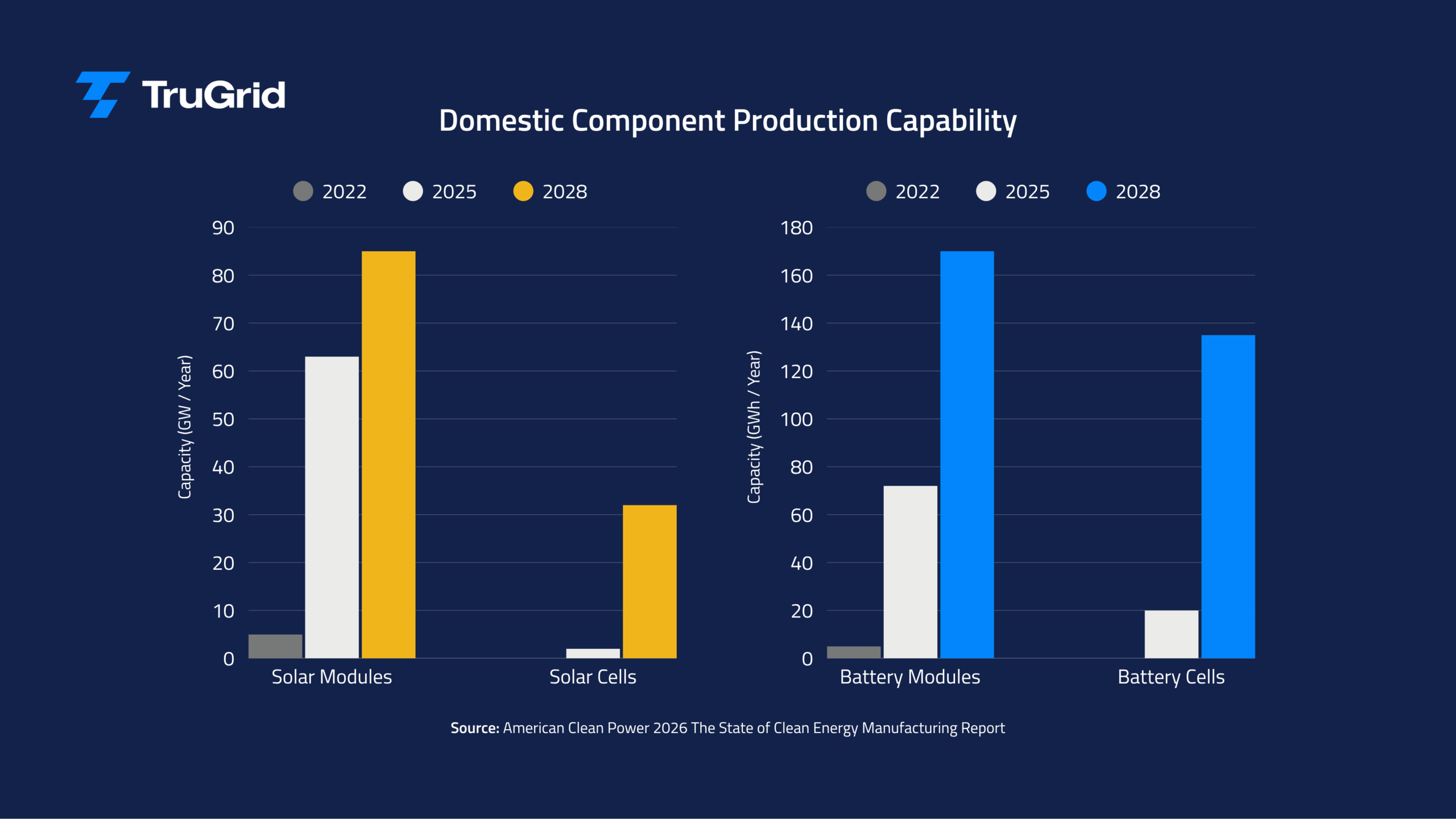
Domestic content capacity of various components is expected to grow to meet and exceed demand by 2028. Source: American Clean Power Association
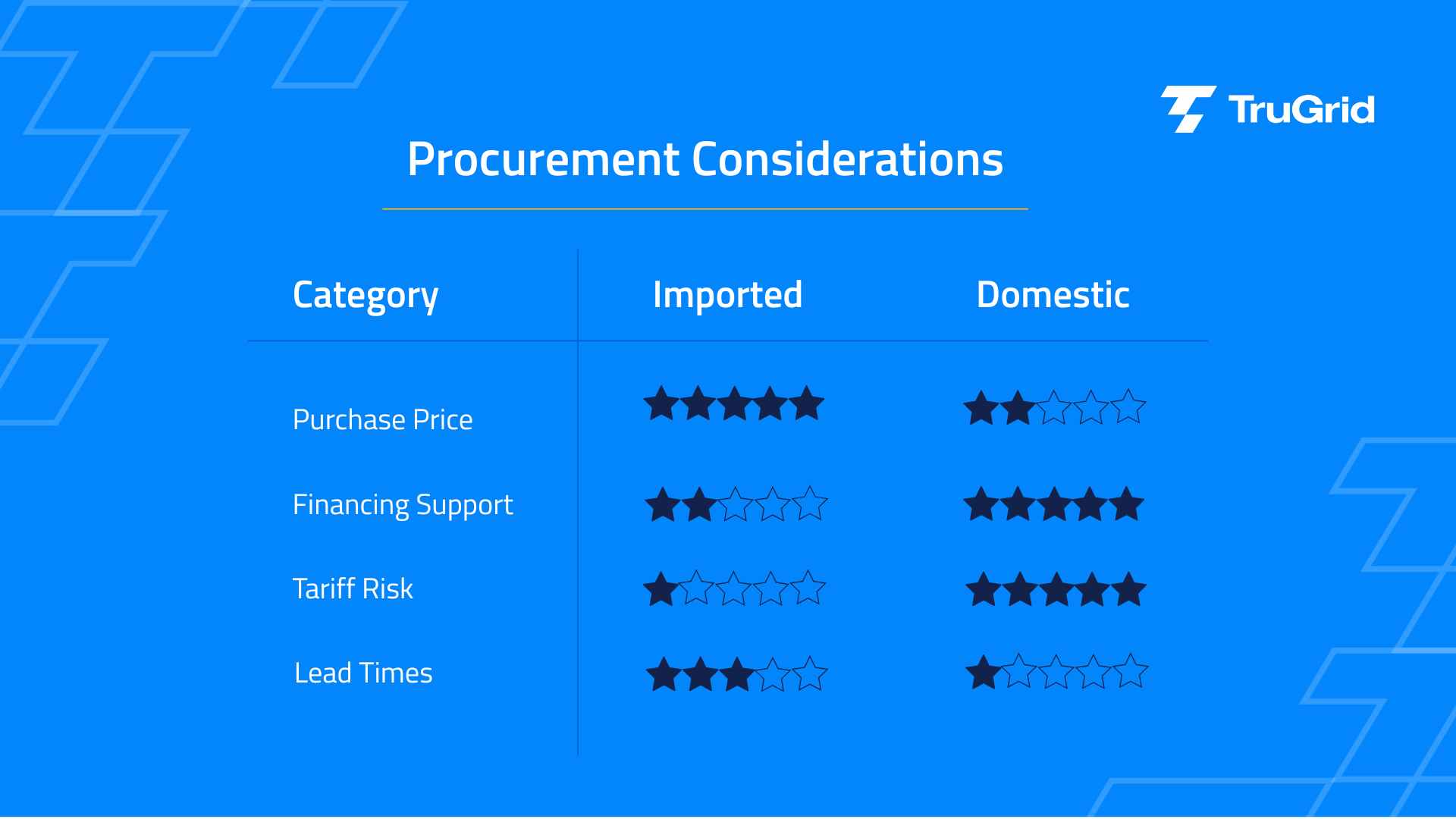
Display of how domestic and imported content have tradeoffs that impact project success.
Production capacity is expected to exponentially grow for the primary components of both solar and BESS. By 2028, there will be more than 80 GW of capacity for solar modules and about 30 GW for solar cells. When it comes to batteries for that time frame, there are expected to be about 170 GWh of modules and 130 GWh of cells.
The True Cost of Equipment Decisions
Cost remains important, but the conversation now goes beyond equipment pricing. Tariffs, domestic content requirements, and supply constraints all influence project economics. This means EPC procurement teams are increasingly evaluating the total impact of sourcing decisions, including price, schedule implications, tariff exposure, domestic content considerations, and long-term project risk.
For example, an imported solution may offer a lower purchase price while introducing additional compliance requirements. Alternatively, a domestic solution may support project incentives or financing goals, but it will likely carry a higher upfront cost and schedule risk.
In many cases, the financial impact of a delayed project exceeds the cost difference between competing equipment options. Understanding those tradeoffs early helps developers make more informed decisions.
Procurement Has Become a Financing Decision
Perhaps the biggest shift is procurement’s growing influence on a project’s financial decisions. Lenders and investors are paying closer attention to equipment sourcing strategies, supplier qualifications, and compliance documentation. Procurement at TruGrid extends beyond sourcing equipment. Every decision is evaluated with project bankability in mind, including:
- FEOC documentation and compliance requirements
- Country of origin verification
- Supplier financial stability
- Manufacturing capacity and delivery commitments
- Long-term support capabilities
This level of due diligence helps reduce uncertainty and provides greater confidence to developers, lenders, and investors.
What Project Developers Should Do Now
The pace of change is unlikely to slow anytime soon, thanks to evolving tariffs, domestic content capacity expanding, and continuous regulatory changes. Based on what we’re seeing across today’s market, we encourage customers to:
- Engage in procurement discussions early in the development process
- Validate lead times and supplier information frequently
- Ask detailed questions about FEOC compliance and country of origin
- Evaluate schedule risk alongside equipment costs
- Involve your EPC partner early to gain visibility into the market conditions and capabilities of manufacturers and suppliers
Just like our earlier Rubik’s Cube analogy, procurement isn’t solved one move at a time. Every sourcing decision changes the next set of options. We believe successful procurement isn’t about finding the lowest price. It’s about making sourcing decisions that support financing, regulatory compliance, project schedules, and long-term asset performance. Developers who understand those interconnected tradeoffs and plan ahead will be best positioned to reduce risk and improve project bankability.
Want to learn more about how our procurement team helps customers develop more economically friendly projects? Reach out to sales@trugridpower.com.